
I'm Not a Doctor, But...
How academics advance an anti-alcohol agenda.

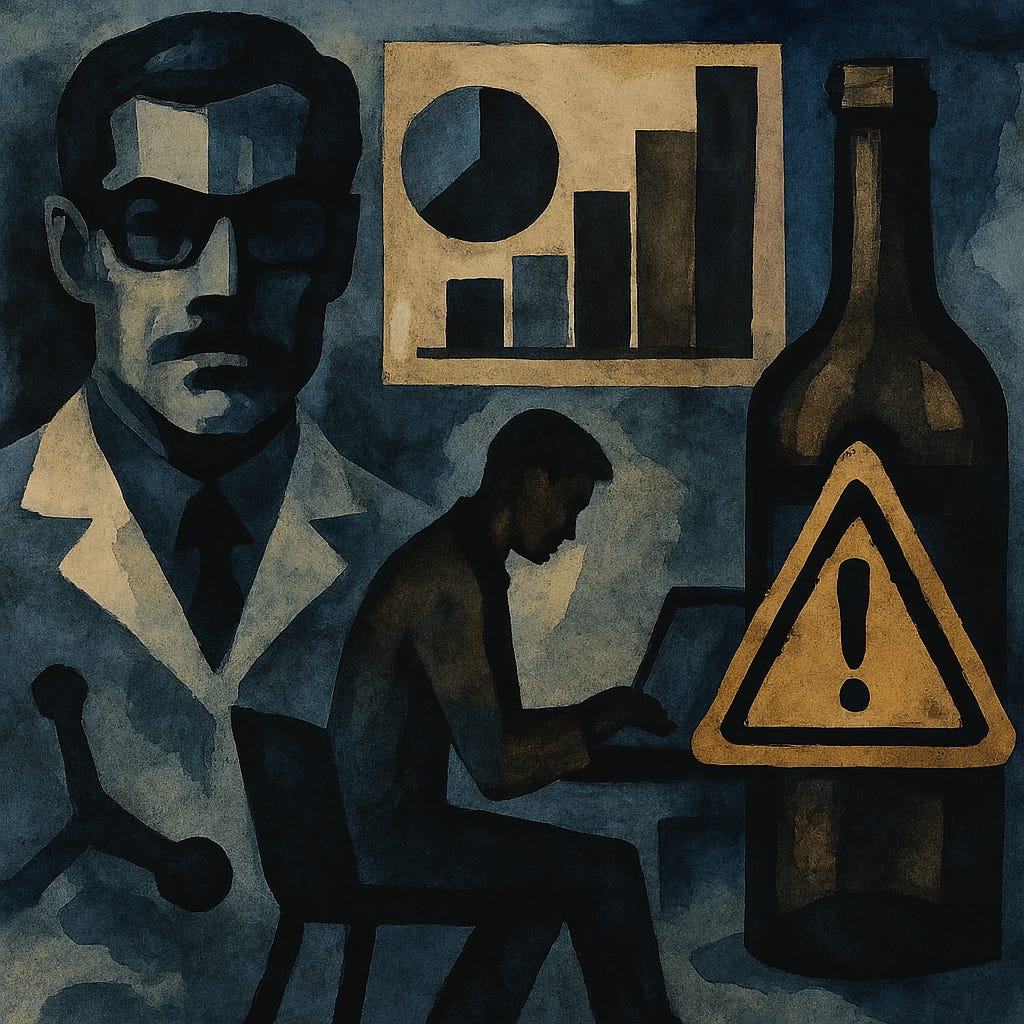
I honestly don’t know what we would all do without the collection of “scientific” researchers who have our best interests at heart and are busy figuring out exactly what we all need.
But, luckily, these busy little research and academic bees are on the case, performing critical research without bias or agenda. Take, for example, Marissa G. Hall, PhD. Dr. Hall is an associate professor at the Gillings School of Global Public Heath a the University of North Carolina. Dr. Hall has a brand new research paper published in the journal Addictive Behaviors, looking at the effectiveness of alcohol warning labels: “Consumer engagement with the US alcohol health warning: A nationally representative study.”
In fact, after leading and analyzing a survey of fully 1,000+ American alcohol consumers, Dr. Hall came to the groundbreaking conclusion that
1. Few adults (27%) read the current US alcohol health warning in the past month.
2. Only 4% correctly recalled all five topics in the current US alcohol health warning.
3. The warning is not read and recalled by many consumers and should be replaced
What lessons can be drawn from this groundbreaking use of an Excel spreadsheet? As you might expect, Dr. Hall has some thoughts she provides in the conclusion to this new study:
“In a nationally representative sample of US alcohol consumers, engagement with and recall of the current health warning on alcohol containers was low, indicating room for label improvements. To be informative and effective, warnings must be noticeable to consumers. Congress should consider strengthening alcohol health warnings to improve the public’s engagement with health information about alcohol.”
While I lack the advanced credentials required to operate a complex Excel spreadsheet, I did find one data point in Dr. Hall’s shiny new study particularly illuminating: “About half (52%) of participants reported noticing the alcohol health warning the last time they saw an alcohol container.”
Again, I’m no doctor or credentialed academic, but having a majority of people notice a government warning label on a rounded glass bottle would seem to suggest the label is, in fact, quite noticeable. Curiously, this majority-affirmation of noticeability didn’t quite make the highlight reel of the study’s primary conclusions. But what do I know? I’m not a specialist in online surveys.
However, if I were somewhat skeptical of researchers and their motivations around alcohol—and I’m not saying I’m that person—I might wonder if Dr. Hall had already pre-determined what the outcome of this new study should be long before she undertook it. I note this only because it turns out that in 2022, Dr. Hall was a co-author of an opinion piece in the New England Journal of Medicine entitled, “Updated Health Warnings for Alcohol — Informing Consumers and Reducing Harm.”
In an interview about the opinion piece published on the website of her own Gillings School of Global Public Health, Ms. Hall said: “The current U.S. warning label hasn’t been updated in more than 30 years and largely goes unnoticed.”
This is precisely the conclusion Dr. Hall reached in her 2025 study, but three years before the current study was published. Not only is she a brilliant “doctor”, but remarkably prescient also. It’s almost as though she didn’t need to do the research to confirm exactly what she said three years earlier. It’s almost as though she knew the results of her current study before she ever did the study. Why, it’s almost as though her preconceived opinions dictated the outcome of her most recent study. But I’m no doctor. So, what do I know?
However, also back in that 2022 interview, Dr. Hall had this to say: “Given the mounting evidence about the harms caused by alcohol, the government has a duty to inform its citizens about these risks.”
Now, I want to emphasize again, I’m no doctor, but that statement sounds very similar to the conclusion Dr. Hall reached in her new research published just this year: “The US should require new, rotating alcohol warnings designed to heighten engagement and better inform consumers.”
I know some tin-foil-hat-wearing people who might look at this coincidence and conclude that Dr. Hall was manufacturing research to support her pre-determined opinion. But honestly, all we can really say is that Dr. Hall has given a little thought to the question of alcohol warning labels.
For example, it turns out that just two months before her opinion piece in the New England Journal of Medicine in 2022 that declared new alcohol warning labels were necessary to “reduce harm” from alcohol, Dr. Hall was a member of a team that published public opinion research on which anti-alcohol labels would be most effective in “discourag[ing] alcohol consumption”: That paper was entitled “Designing Effective Alcohol Warnings: Consumer Reactions to Icons and Health Topics”. The results? We need warning labels on alcohol that include the phrase “increases risk of” and include a big yellow icon.
And, Dr. Hall has dabbled in this area a bit more. Among the papers she has published are these:
Health harms that discourage alcohol consumption: A randomized experiment of warning messages. Addict Behav. Epub 2024 Aug 17
The impact of "pinkwashed" alcohol advertisements on attitudes and beliefs: A randomized experiment with US adults. Addict Behav. 2024
Designing effective alcohol warnings: consumer reactions to icons and health topics. Am J Prev Med. 2023
Reactions to graphic and text health warnings for cigarettes, sugar-sweetened beverages, and alcohol: An online randomized experiment of US adults. Prev Med. 2020
It also turns out that Dr. Hall is one of principle investigators of a National Institute of Health-funded project on “Informing alcohol policy: The impact of evidence-based alcohol warnings on consumption.” Her project was granted $3,000,000.
Now, again, not being a doctor, but a lowly reporter of information, I’m not necessarily suggesting that Dr. Hall and perhaps others have an agenda and they are creating government and university-funded research that delivers results supporting their agenda. And I’m not saying that agenda includes “discouraging alcohol consumption” rather than discouraging excessive and unsafe alcohol consumption.
But…if I were saying this, I might note that there is a very tried and very true formula for pushing this kind of agenda toward outcomes. For one, you need research that supports the agenda. CHECK. You need respected “researchers” who have carried out this research CHECK. These researchers would need to cite other respected people and organizations that support the agenda, such as the U.S. Surgeon General and the World Health Organization. CHECK. Research would need to be in place that provides a framework for successfully communicating on every bottle of alcohol, that drinking (not excessive drinking, but simply drinking) is very bad for you. CHECK.
Finally, if I were a lawmaker in Washington, D.C. who thought the U.S. government needed to make it more difficult for wineries to sell more wine in an effort to reduce something they are calling “alcohol harm”, I might be inclined to look around for an academic who could support my agenda. I might look for an academic who has already demonstrated an inclination to engage in advocacy that denigrates the interests of industry. I might put a white coat on them and invite them before a congressional committee to testify why current alcohol warning labels simply aren’t working, since only 50% of those who last encountered a bottle of alcohol noticed the warning label. (It begs the question, does it need to be 100% before the labels are effective?)
But what do I know, other than I suspect we will be hearing from Dr. Marissa G. Hall more, particularly once new alcohol warning labels are proposed. And they will be.
Having read through Dr. Hall’s research and opinions, I think I know what those warning labels will look like. I’ll use one of my favorite wines, the Pinot Noirs from Occidental Winery in the Far Sonoma Coast, as an example:
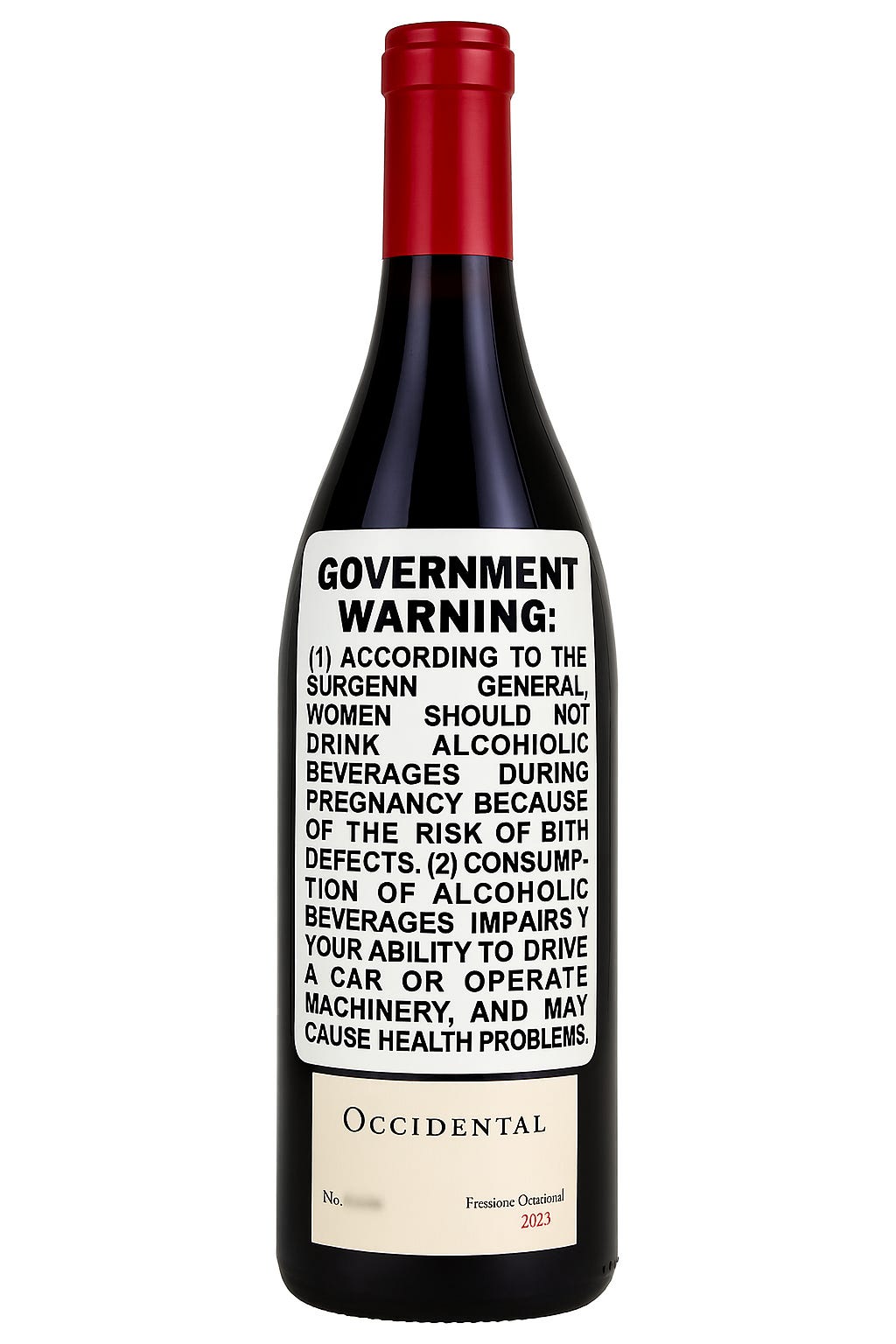
Dr. Hall is the tip of an iceberg of academics currently working toward the goal of implementing policies meant not to deter excessive alcohol consumption, but rather to curtail all alcohol consumption, whether responsible or not. This latter goal is accomplished by producing research with an outcome pre-determined to support a specific conclusion. It’s accomplished by advocating for the shaming of alcohol consumption. It’s accomplished by making hysterical claims that the wine, beer, and spirits industry doesn’t care about health and safety. And it’s accomplished by deploying advocates on behalf of the cause who are disguised in white coats.
By Tom Wark
Tom Wark is the publisher of Fermentation, a source of commentary on the wine business that he has written since 2004. He is also the publisher of THE SPILL, a free, daily newsletter that curates the best wine content on the web.
Follow the money. 💰
Great analysis. To paraphrase Mark Twain: There are lies, then there are damned lies, and finally there are statistics. While academic researchers definitely need data to prove their hypotheses, when they've clearly already made their minds up before the research is done, it completely undermines any credibility.