

Let’s take account:
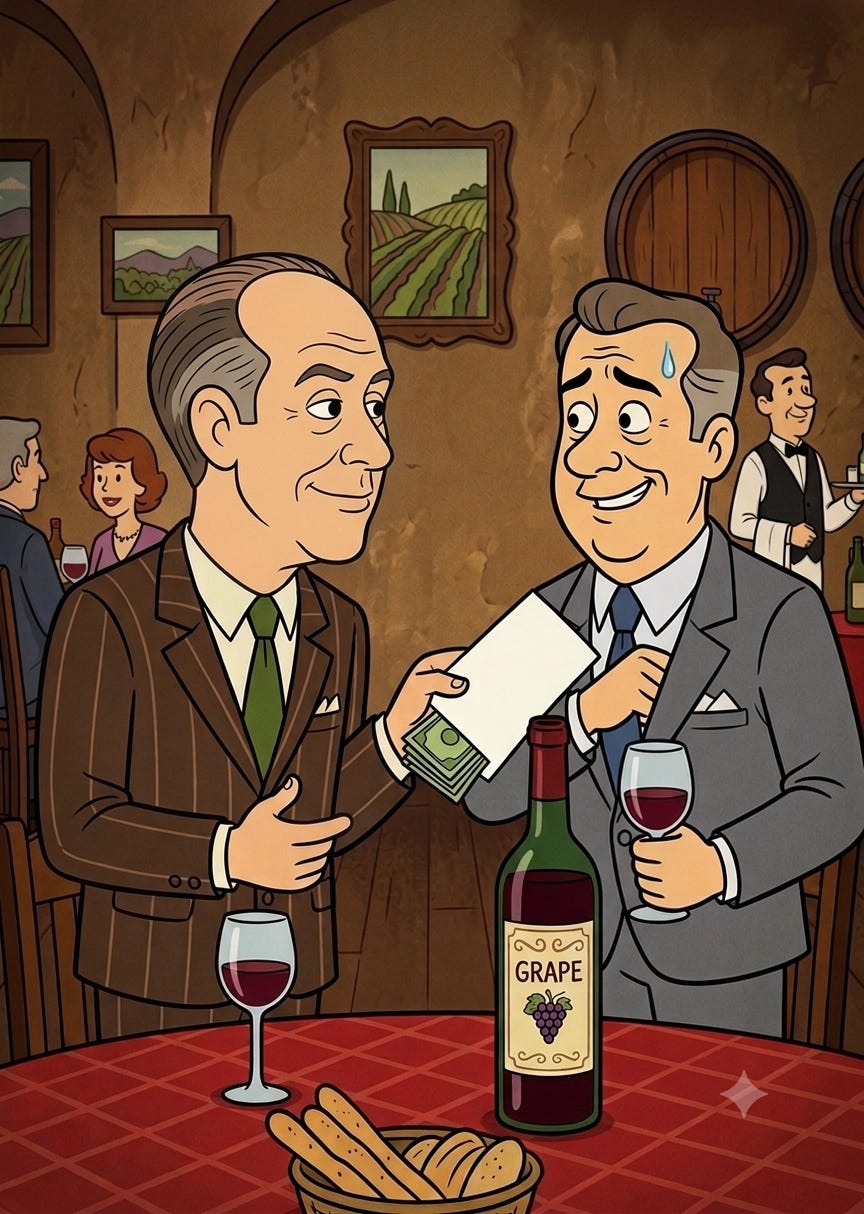
-On September 11, the Federal government announced it had entered into a Non-Prosecution agreement with Southern Glazer's Wine & Spirits and had assessed the largest wine and spirits distributor with a $12.5 million fine. According to the agreement, Southern Glazer's staff were engaged in a scheme to bribe grocery store buyers.
In December 2017, the New York State Liquor Authority assessed Southern $3.5 million in civil penalties for a bribery scheme in that state.
Also in 2017, the U.S. Attorney’s Office assessed a fee of $5 million against Southern for bribing officials at the Pennsylvania Liquor Control Board.
Translation: Southern Glazer's Wine & Spirits, the largest alcohol wholesaler in America and which controls 1/3 of the wine and spirits distribution market, is a serial offender and a serial briber.
But here’s the thing. Not only does no one care who should, but those who should be working to dissuade Southern from breaking the law are actually incentivizing Southern to offer more bribes.
For its admitted crimes, Southern was assessed a $12.5 million fine. Southern Glazer’s annual revenue is estimated to be at least $26 billion. So, this fine amounts to one-tenth of one-half of one percent of Southern’s annual revenue
In accounting terms, this $12.5 million fine is considered a “rounding error”. In the world of corporate governance, this $12.5 million fine would be considered far below the threshold of "materiality"—meaning on its own, it is not enough to impact the overall financial health or viability of the company.
I’ve spoken to a number of people who have read the details of the bribery scheme Southern Glazer’s undertook in California, and not one of them believed the $12.5 million fine amounted to the revenue that the bribery scheme generated. Another way to put this is the Fed’s $12.5 million fine was an endorsement of bribery as a business strategy.
But not to worry. As part of its non-prosecution agreement with the Feds, Southern Glazer’s promised to “implement robust steps to enhance compliance with federal and state laws prohibiting bribery and other improper payments”.
This should be comforting since back in 2017, as part of its non-prosecution agreement with the federal government after bribing the Pennsylvania Liquor Control Board, Southern Glazer’s promised to “implement compliance measures and refrain from engaging in similar activities in the future.”
Given Southern Glazer’s clear devotion to bribery as a sales strategy, I think if I were the owner of one of the 7,000 brands they represent, I’d want to know if they were using this strategy to move my wines. Unfortunately, I think if I have to ask that question, then the answer would certainly be “no.” Previous indictments demonstrate that certain producers and brand owners were also closely involved in this bribery scheme.
Southern Glazer’s holds federal and state permits. That is, in order to wholesale wine and spirits, it must obtain special permits from the federal government and the states where it operates (which is nearly all of them). What this latest bribery scandal indicates is that the holding of a federal permit is not the source of deterrence that the wholesalers themselves say it is.
Having spent some time working on lawsuits meant to liberalize wine distribution laws, one of the things I’ve witnessed over and over is the wholesaler and the state arguing in front of federal courts that retailers are more difficult to regulate and should, therefore, not be given the same kind of wine shipping privileges as the federal permit-holding wineries because retailers do not have to hold a federal permit. They only have to hold state permits. Not being threatened with losing a federally issued permit will, the argument goes, lead retailers to violate the law more readily.
It’s a facile argument that is theoretical in nature, while experience proves otherwise.
But more importantly, this latest bribery scandal with Southern-Glazer’s demonstrates that holding a federal permit does not deter anything. Three times now, the feds have caught Southern red-handed bribing retailers and representatives of state agencies. Three times there has been no revocation of their federal permit. Just meager fines that actually incentivise a future bribing strategy instead of deterring it.
There is every reason to believe that the same bribery sales strategy is ongoing in other states and that we will see future federal investigations. It looks more and more like Southern can’t help itself.
Not only are the fines too small to cause any pain to the cheating monopolizing corporation, but the money does not flow to all the small producers and distributors harmed by results of the bribery.
Three tier has become the very problem it was created to correct for. This isn't just a problem for the alcohol industry... the meddling and cheating middleman is ubiquitously corruptive to the principles of a free market where all producers should have equal access to the consumer.
The problem here is that the pay-for-placement game is too big for the small population of regulators to deal with.
Asking a bartender of a busy and popular restaurant why our products from our distillery down the street where not on display, but inferior products from a distillery located far away, but owned by a partnership of investment bankers, has a prominent location clearly established as a show display, and without any hesitation or concern the bartender explained that the restaurant owners is being paid for that placement.
So, what I am I to do? If I report them, the restaurant owner stops buying my products for having lost him the payments from the other producer. If I also pay for placement, I am breaking the law and contributing to the race to the bottom with this practice.
Here is another bribery scheme that flies under the radar. The big distributors have taken over managing the inventory and shelf-management for retailers. The distributor's system is integrated with the retailer system, and the distributor keeps track of inventory and sales data, and buys and places products for the retailer to maximize the revenue that the distributor and retailer derive from it. This is free labor and free service that puts smaller distributors and smaller producers that utilize self-distribution at a disadvantage.
Again, what do I do? If I report it, assuming that any government agency would care to pursue this type of thing as another form of bribery, the grocery store chain cuts me off for causing them larger economic pain. But I cannot afford that high cost of this type of system integration and service. Only a large corporation can justify it because of the economies of scale.
Again, the conclusion here is that three tier should be canceled. The alcohol distribution tier has become a racket that corrupts competition.
As a long time wine industry person who has seen their egregious behavior first hand and personally knows one of those charged with the crimes approved of by Southern, it is horrific to see them cast off the people who did their bidding with a wink and a nod and an approving handshake for the good of the company (and their annual numbers). And those suppliers need to be called out as well. The court of public opinion needs to hold these suppliers accountable. The 3-tier system needs to be dismantled.